
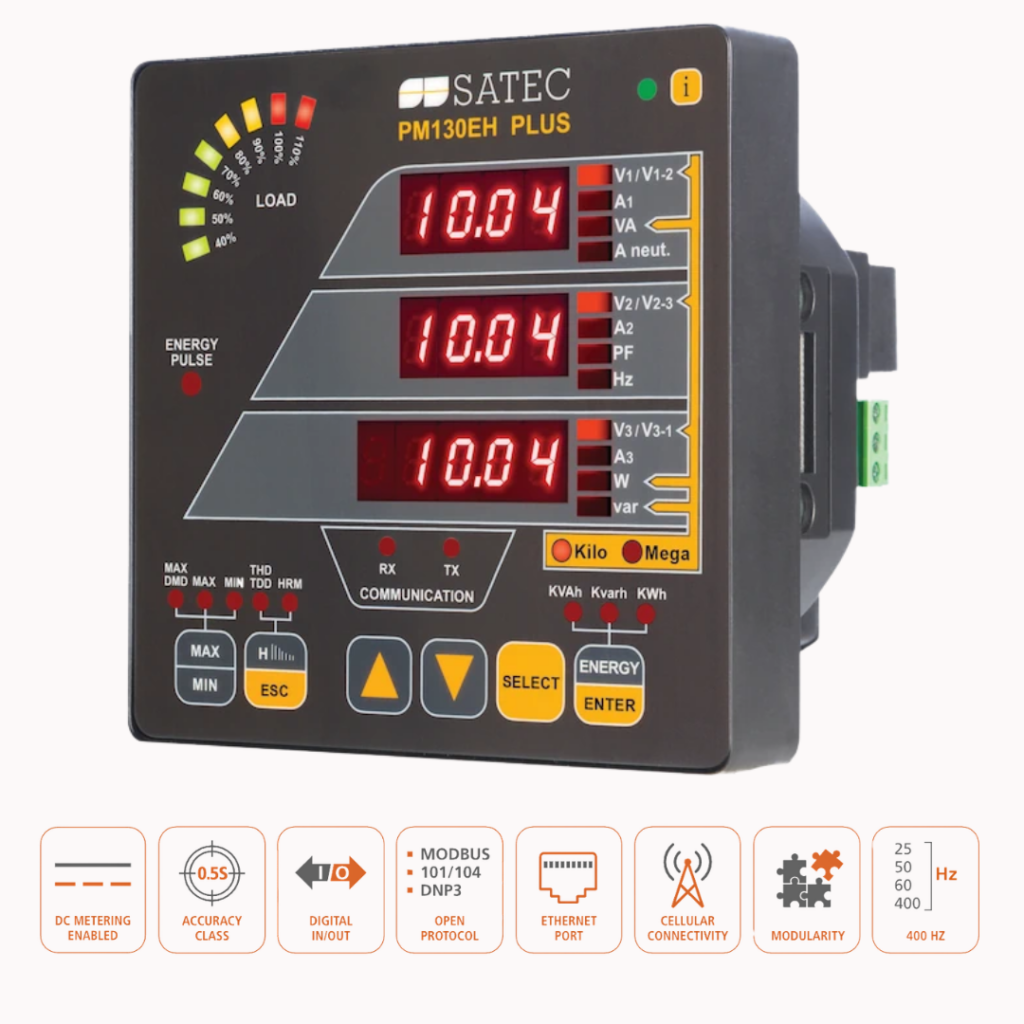
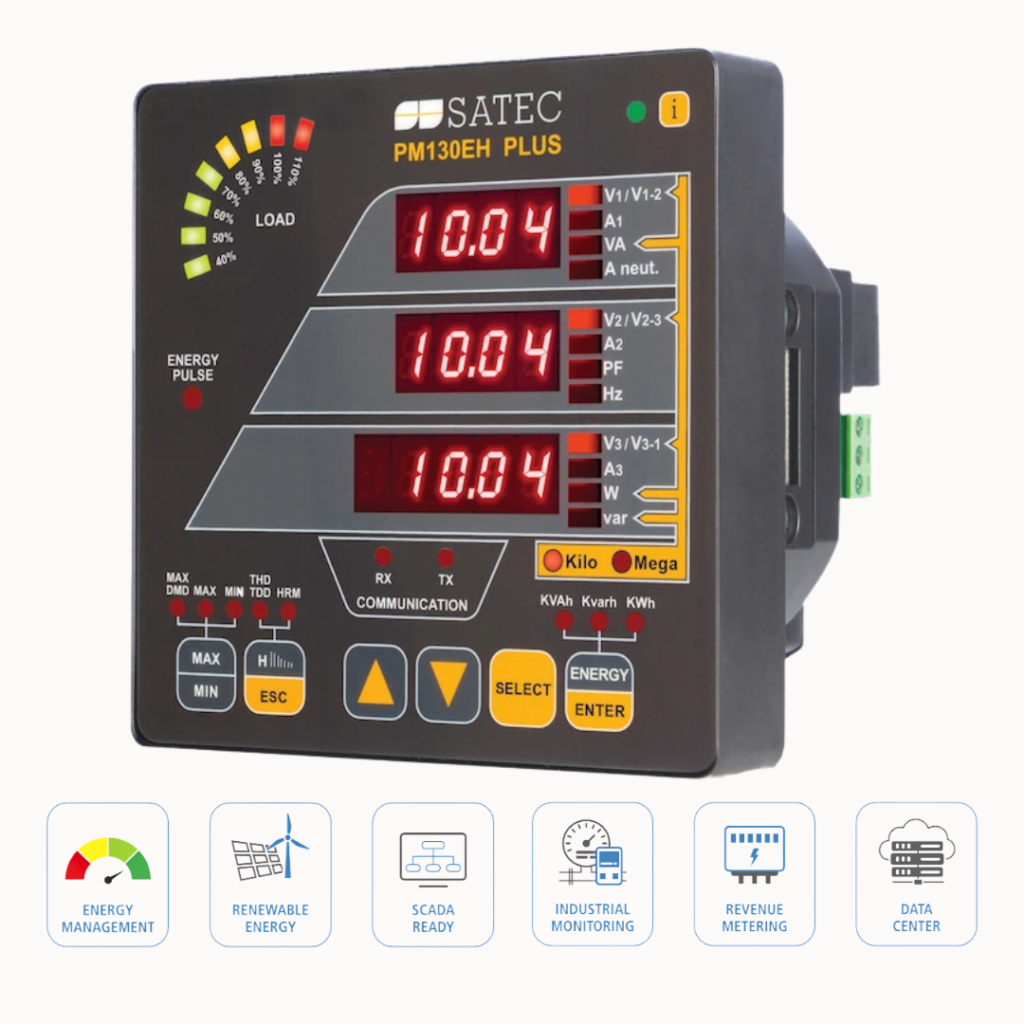
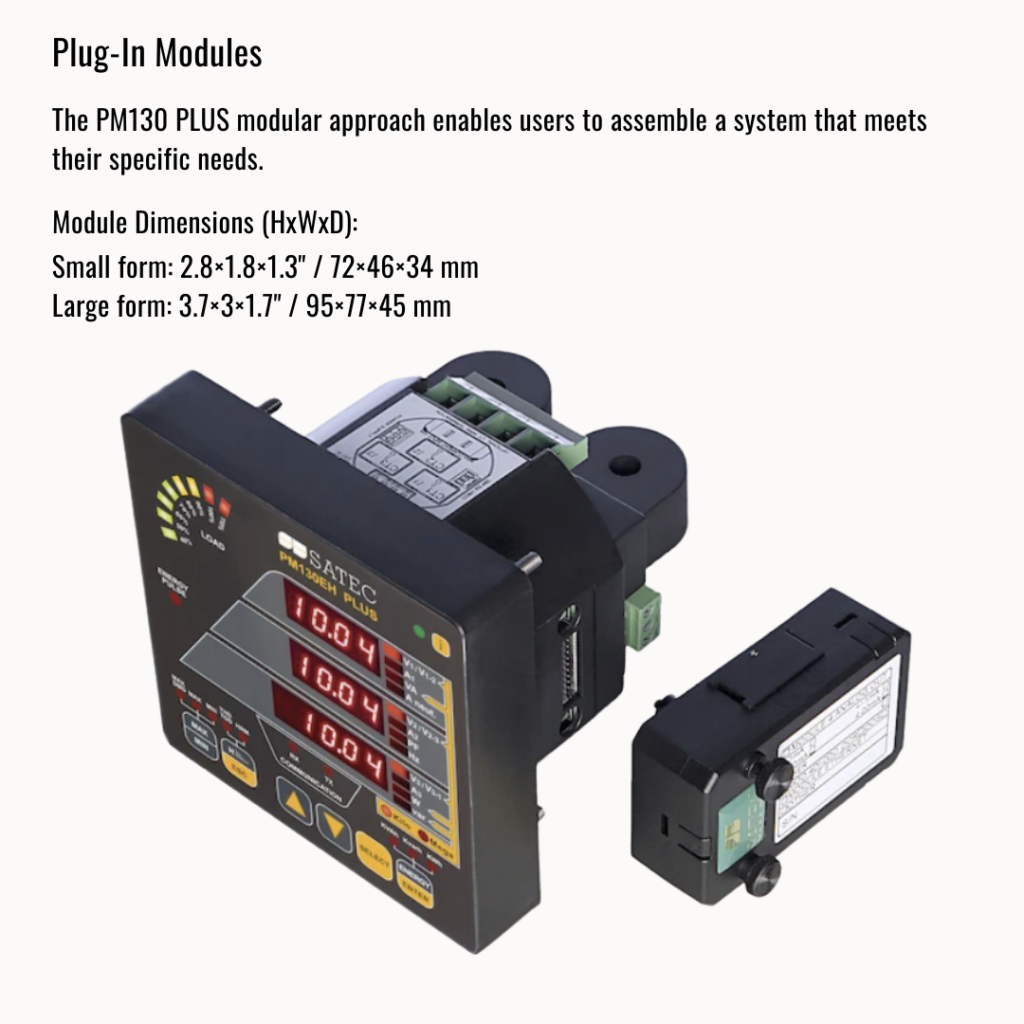
The PM130 PLUS measures voltage, current, power, energy and frequency, with support for multiple communication protocols and plug-in I/O expansion modules. All models share the same communication and control platform, which keeps integration consistent across projects and panel designs.
The PM130 PLUS is commonly specified for switchboards, motor control centres (MCCs) and metering panels where stable kWh data, demand values and clear system visibility are required without the overhead of a full power quality analyser.
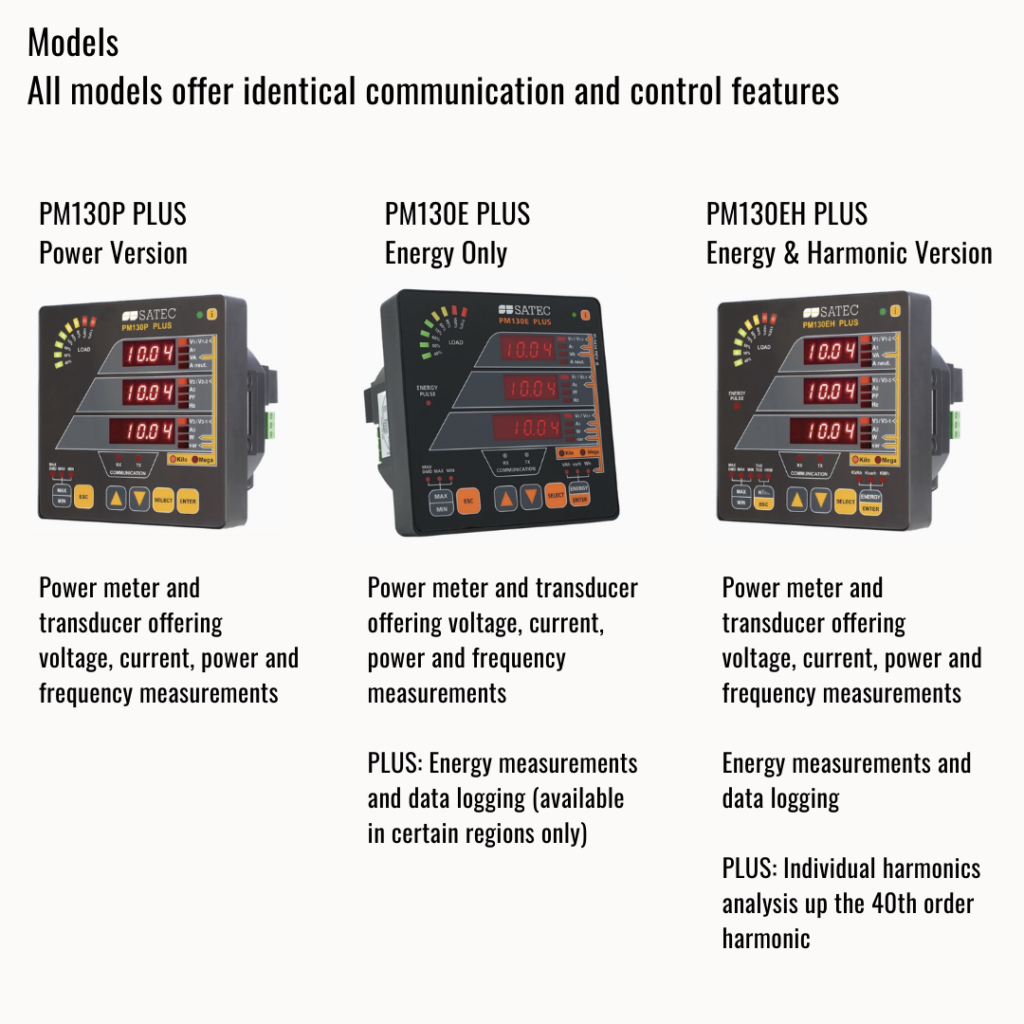
PM130P PLUS – Power meter
PM130E PLUS – Energy meter
PM130EH PLUS – Energy meter with harmonic measurement
The SATEC PM130 PLUS is built for three-phase metering in LV and MV panels, using external current transformers (CTs) sized to the feeder or circuit. It measures phase-to-phase and phase-to-neutral voltages, line currents, active/reactive/apparent power, energy (kWh, kvarh, kVAh) and frequency, and remains stable on both balanced and unbalanced loads.
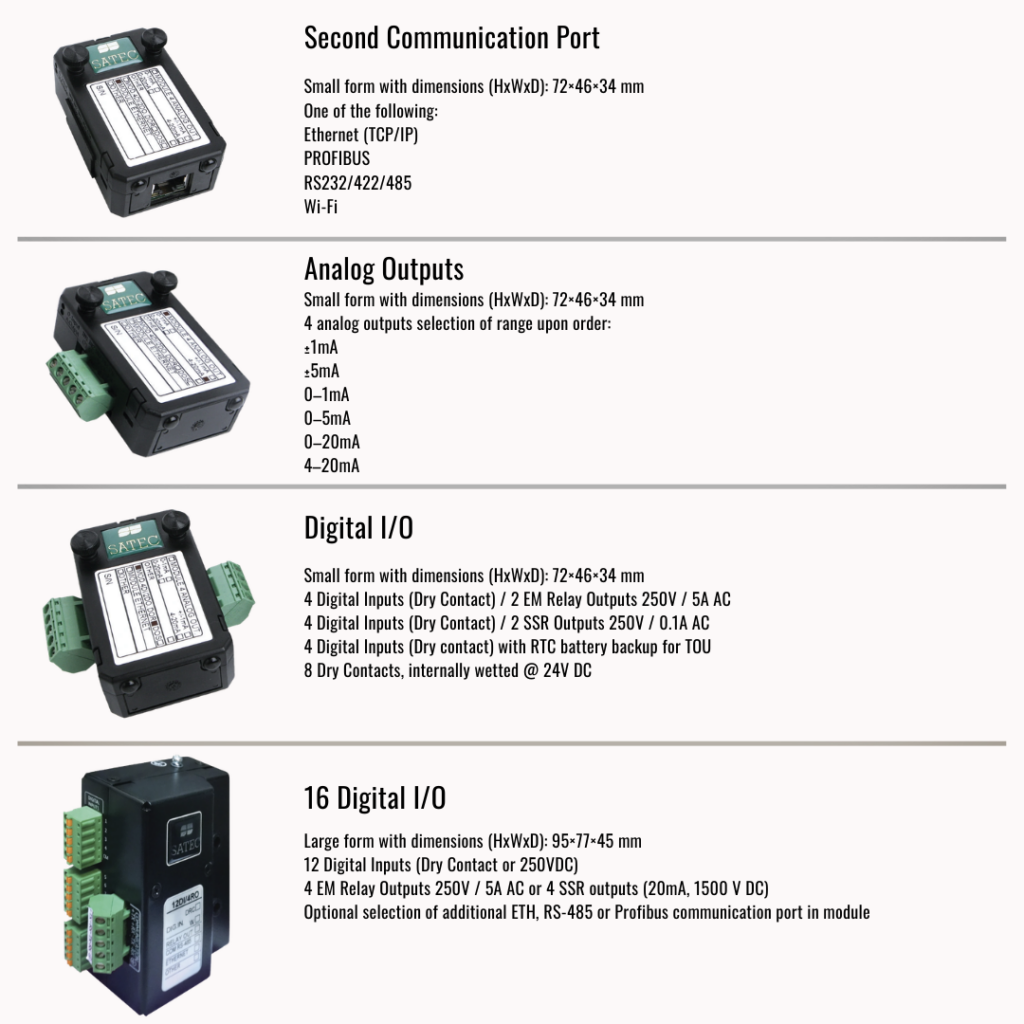
The PM130 PLUS uses a modular I/O concept. Depending on the build, you can add plug-in communication and I/O modules such as digital inputs, relay outputs and analogue outputs. This makes it straightforward to bring status signals, alarms and control points into the same meter used for energy and electrical measurements.
The PM130 PLUS provides event logging for operational and diagnostic purposes, recording time-stamped alarms, setpoint activity and selected status changes. This allows engineers to review system behaviour during commissioning and basic fault investigation.
Depending on the model and configuration, the meter also supports waveform capture associated with selected events. This provides additional visibility into voltage and current behaviour where required, without the need for a dedicated power quality analyser.
The SATEC PM130 PLUS multifunction power meter includes an RS-485 interface with Modbus RTU for integration with PLC and SCADA systems. Additional protocols are available via plug-in communication modules, including Ethernet, PROFIBUS DP, DNP3 and IEC 60870-5-101/104, which supports utility and industrial interoperability requirements.
I/O is expanded using dedicated plug-in modules. Depending on configuration, the meter can be fitted with digital inputs for status monitoring, relay outputs for alarms or simple control, and analogue outputs for legacy interfaces. The modular approach lets you specify only the communications and I/O you need, without changing the base meter.
The PM130 PLUS is used for industrial and utility metering where stable electrical and energy data is needed for monitoring, reporting and basic control. It is commonly installed in LV and MV switchboards for incomer and feeder metering, sub-metering and panel-level energy monitoring.
Typical use cases include industrial plants, commercial sites and infrastructure projects, as well as utility installations where the meter is integrated into PLC or SCADA systems to provide measured values, energy totals and demand data. It is also a practical choice for retrofit work, where modular communications and I/O help bring existing panels into a modern monitoring platform with minimal disruption.
The PM130 PLUS measures voltage, current, power, energy and frequency, with support for multiple communication protocols and plug-in I/O expansion modules. All models share the same communication and control platform, which keeps integration consistent across projects and panel designs.
The PM130 PLUS is commonly specified for switchboards, motor control centres (MCCs) and metering panels where stable kWh data, demand values and clear system visibility are required without the overhead of a full power quality analyser.
PM130P PLUS – Power meter
PM130E PLUS – Energy meter
PM130EH PLUS – Energy meter with harmonic measurement
The SATEC PM130 PLUS is built for three-phase metering in LV and MV panels, using external current transformers (CTs) sized to the feeder or circuit. It measures phase-to-phase and phase-to-neutral voltages, line currents, active/reactive/apparent power, energy (kWh, kvarh, kVAh) and frequency, and remains stable on both balanced and unbalanced loads.
The PM130 PLUS uses a modular I/O concept. Depending on the build, you can add plug-in communication and I/O modules such as digital inputs, relay outputs and analogue outputs. This makes it straightforward to bring status signals, alarms and control points into the same meter used for energy and electrical measurements.
The PM130 PLUS provides event logging for operational and diagnostic purposes, recording time-stamped alarms, setpoint activity and selected status changes. This allows engineers to review system behaviour during commissioning and basic fault investigation.
Depending on the model and configuration, the meter also supports waveform capture associated with selected events. This provides additional visibility into voltage and current behaviour where required, without the need for a dedicated power quality analyser.
The SATEC PM130 PLUS multifunction power meter includes an RS-485 interface with Modbus RTU for integration with PLC and SCADA systems. Additional protocols are available via plug-in communication modules, including Ethernet, PROFIBUS DP, DNP3 and IEC 60870-5-101/104, which supports utility and industrial interoperability requirements.
I/O is expanded using dedicated plug-in modules. Depending on configuration, the meter can be fitted with digital inputs for status monitoring, relay outputs for alarms or simple control, and analogue outputs for legacy interfaces. The modular approach lets you specify only the communications and I/O you need, without changing the base meter.
The PM130 PLUS is used for industrial and utility metering where stable electrical and energy data is needed for monitoring, reporting and basic control. It is commonly installed in LV and MV switchboards for incomer and feeder metering, sub-metering and panel-level energy monitoring.
Typical use cases include industrial plants, commercial sites and infrastructure projects, as well as utility installations where the meter is integrated into PLC or SCADA systems to provide measured values, energy totals and demand data. It is also a practical choice for retrofit work, where modular communications and I/O help bring existing panels into a modern monitoring platform with minimal disruption.
We use cookies to improve site performance, analyse usage and support our services.
You can accept all cookies, reject non-essential ones, or adjust your preferences.